

Do you want to take the scenery of your Betta fish tank to the next level by adding some plants, but have no clue what plant to choose? Luckily, this post presents the best plants for Betta fish tanks. These aquatic plants are safe, easy to care for, and beautiful options for any new Betta fish tank.
- Why Bettas Benefit from Live Aquarium Plants
- Best Live Plants for Betta Aquariums (Top Picks)
- 1. Java Fern (Microsorum pteropus)
- 2. Anubias (Anubias spp.)
- 3. Amazon Sword (Echinodorus bleheri)
- 4. Marimo Moss Ball (Aegagropila linnaei)
- 5. Cryptocoryne (Cryptocoryne wendtii)
- 6. Water Wisteria (Hygrophila difformis)
- 7. Vallisneria (Vallisneria spiralis)
- Best Floating Plants for Betta Fish
- Plants to Avoid in Betta Tanks
- How to Choose the Right Plants for Your Betta Tank
- How to Plant and Care for Betta Aquarium Plants
- Low-Maintenance Plants for Beginners
- Final Thoughts — Creating a Comfortable Planted Home for Your Betta
- Frequently Asked Questions (FAQs)
Naturally, Betta splendens thrive in a warm, shallow, slow-moving, and plant-rich aquatic environment. Therefore, it’s not surprising that Bettas love planted tanks, which mimic their natural environment and provide enrichment and security.
Aside from providing a beautiful, natural environment for your Betta to rest, explore, and hide, live aquatic plants, which are available in floating, rooted, and low-light options, also improve oxygenation.
The next section explains in detail the major benefits Bettas derive from live aquatic plants.
Why Bettas Benefit from Live Aquarium Plants
Adding live plants to Betta tanks offers numerous benefits that are essential for the happiness and health of Bettas. Some notable benefits include the following:
Reduce Betta stress by providing cover: Naturally, Bettas thrive in shallow marshes, such as heavily vegetated rice paddies. This is because Bettas feel more secure when they have places to retreat, rest, and hide.
These plants create visual barriers and cover that allows Bettas to feel safe and rest, encouraging more vibrant activities and coloring.
Improve water quality by absorbing waste: Live aquarium plants significantly improve water quality by absorbing waste in the water column, acting as natural biological filters.
During photosynthesis, plants absorb harmful byproducts in fish waste, such as nitrate, nitrite, and ammonia.
By acting as natural purifiers, these plants improve oxygenation, outcompete nuisance algae for nutrients, and help stabilize water parameters. This process leads to a cleaner and healthier environment for your Betta fish.
Encourage natural behaviors like resting and hiding: Transforming a Betta tank into a more natural, thriving ecosystem with live aquarium plants, especially those with dense foliage, encourages these behaviors.
Naturally, Betta fish love to lounge, and aquarium plants act as a natural bed for them to rest their delicate, heavy fins..
Best Live Plants for Betta Aquariums (Top Picks)
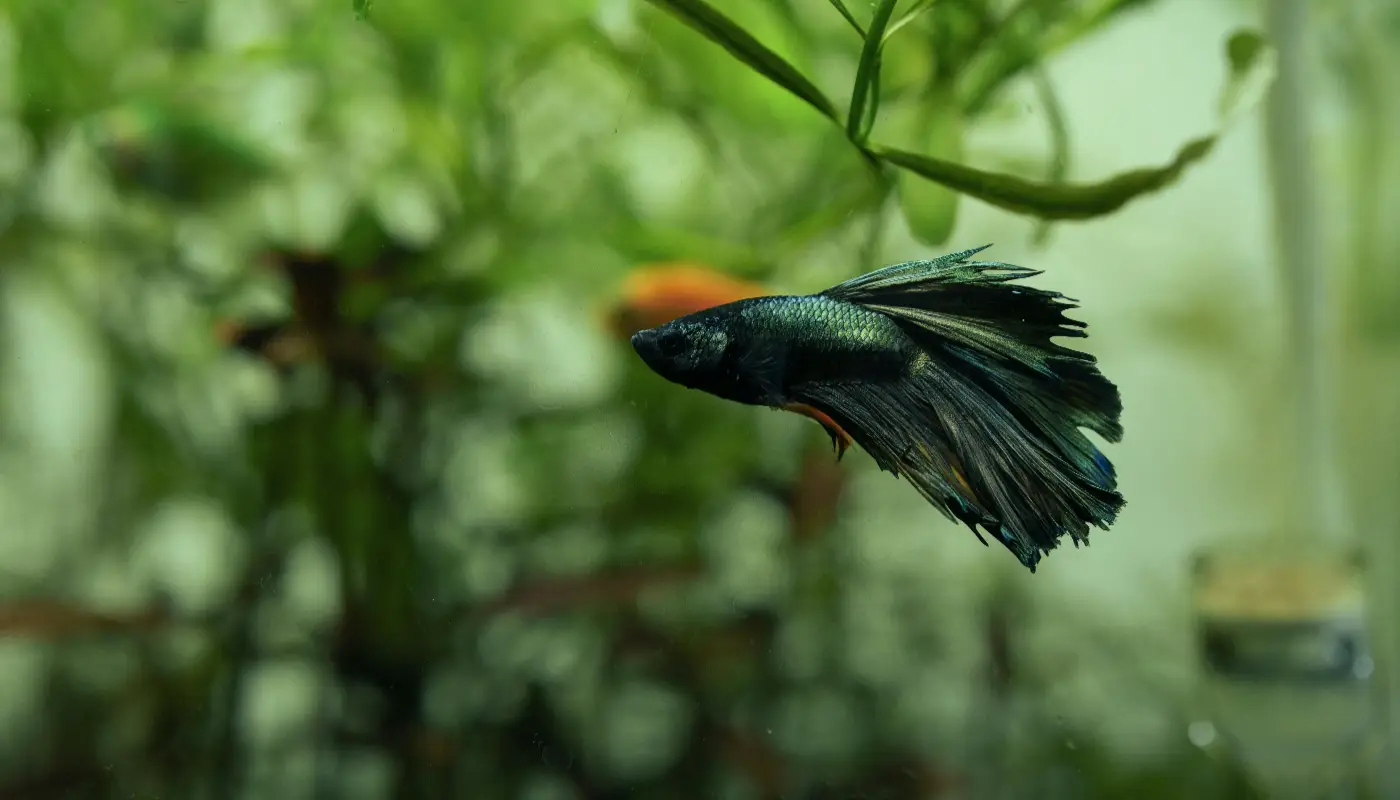
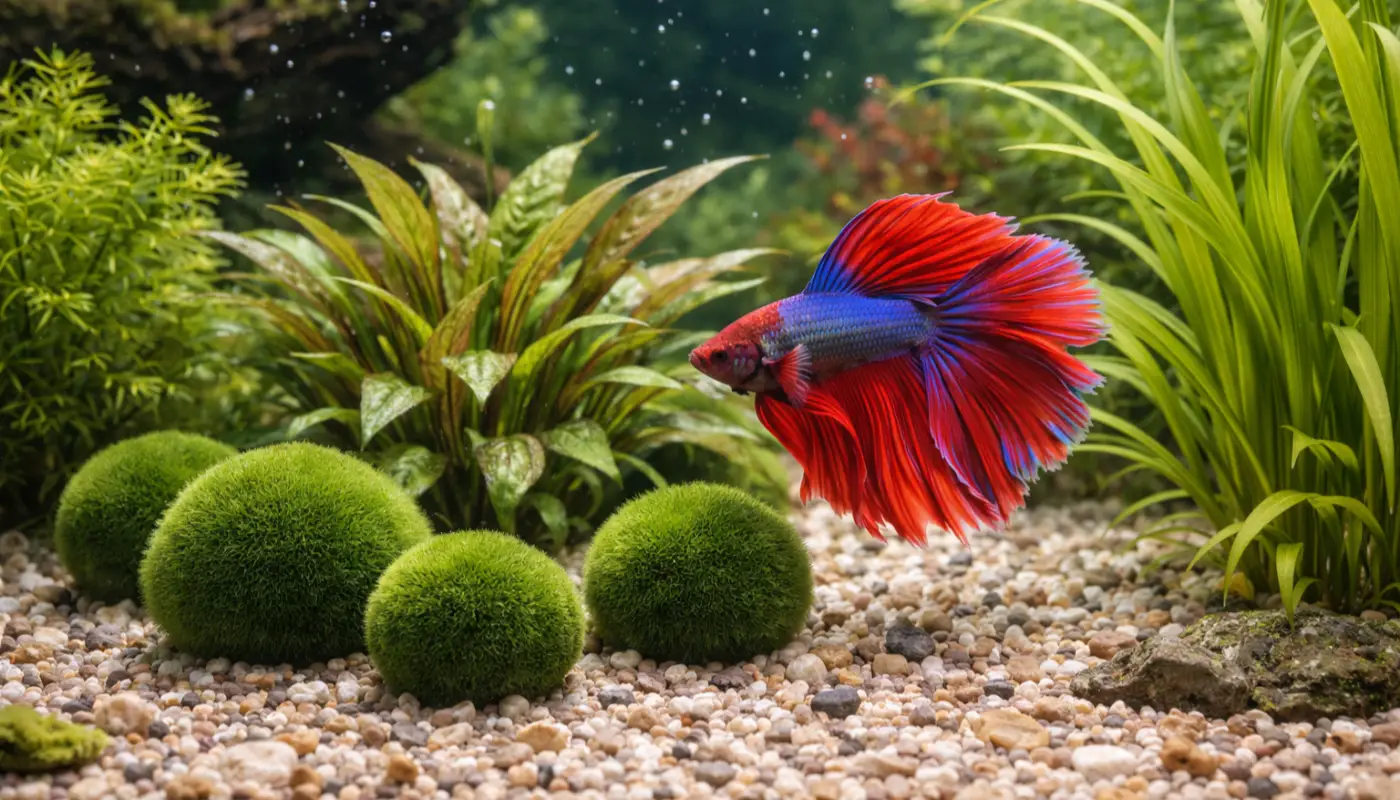
Live plants benefit both Betta fish and aquariums by providing natural enrichment, reducing stress, and maintaining water quality.
That being said, here are some of the best live plants for Betta aquariums, grouped by their placement:
1. Java Fern (Microsorum pteropus)
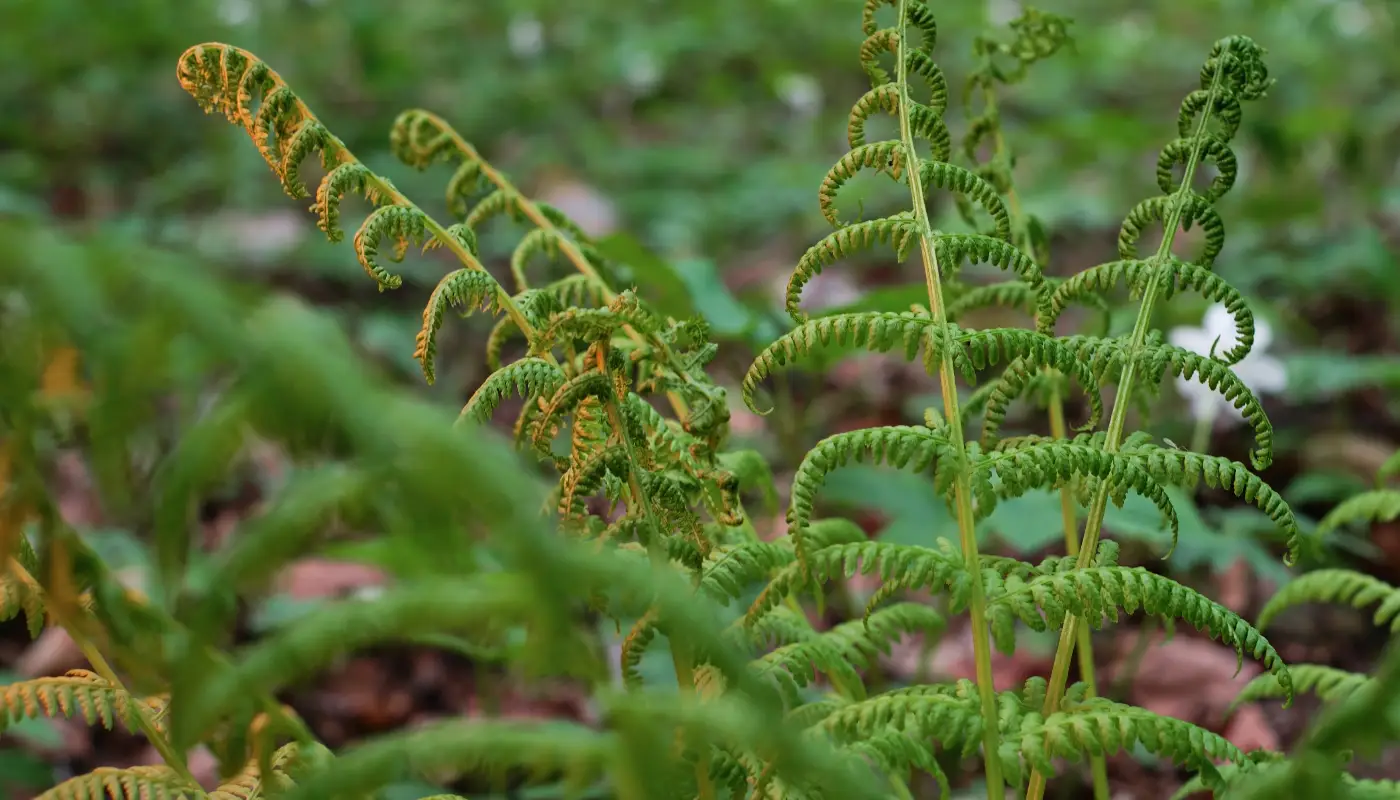
The first option on our list is Java fern, a hardy, low-light plant that is perfect for filling bare-bottom tanks.
Java fern is a slow-growing plant with long, thick, low-maintenance leaves, making it an ideal option for beginners. This plant is available in various varieties, including Trident, Narrow Leaf, Windelov, and Mini Java fern.
Java fern has a thick, horizontal stem called a “rhizome.” The rhizome produces roots at the bottom and leaves on top.
Java fern’s rhizomes are epiphytic and should not be buried, as they don’t require any substrate or gravel to grow. You only need to attach it to a driftwood or rock using any suitable material and place it anywhere you like in the aquarium.
Reproducing is simple and interesting. Simply cut the rhizome to split the plant into two or more parts – propagation. Sometimes, little plantlets can pop out directly from the leaves. Once these plantlets are big and have enough roots, you can detach and replant them elsewhere in the Betta tank.
Betta-friendly Java fern not only provides cover and enrichment for Bettas, it also improves water quality by absorbing nitrates.
2. Anubias (Anubias spp.)
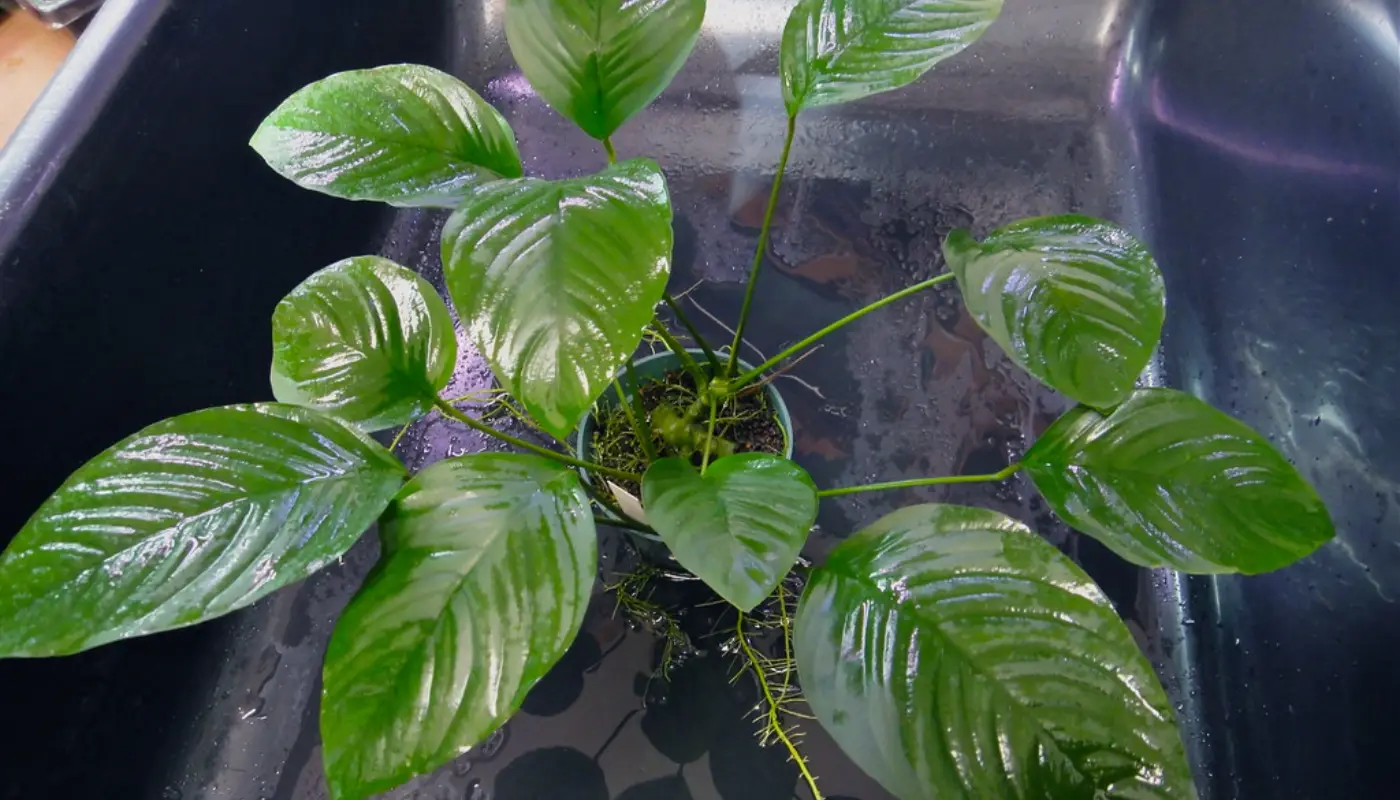
Anubias is another popular rhizome plant for Betta aquariums. Just like Java fern, it has slow-growing, thick leaves that encourage resting.
Anubias spp. is available in different varieties, shapes, sizes, and textures. Some varieties work better for Bettas than others. Some of the best varieties for Betta fish include Anubias barteri, Anubias nana petite, Anubias coin leaf, and Anubias coffeefolia.
Like Java Fern, Anubias consumes its nutrients from the water column rather than the ground, and doesn’t require substrate. So, it is commonly attached to various hardscape elements, such as driftwood, rocks, and aquarium decor.
However, if you have substrate in your tank, be careful not to bury the rhizome directly into the substrate, or else the plant may die.
We recommend using any Anubias nana for low-tech 3- or 5-gallon tanks, as its leaves suit such small tanks. If you have a larger tank, try Anubias Barteri with longer leaves.
3. Amazon Sword (Echinodorus bleheri)
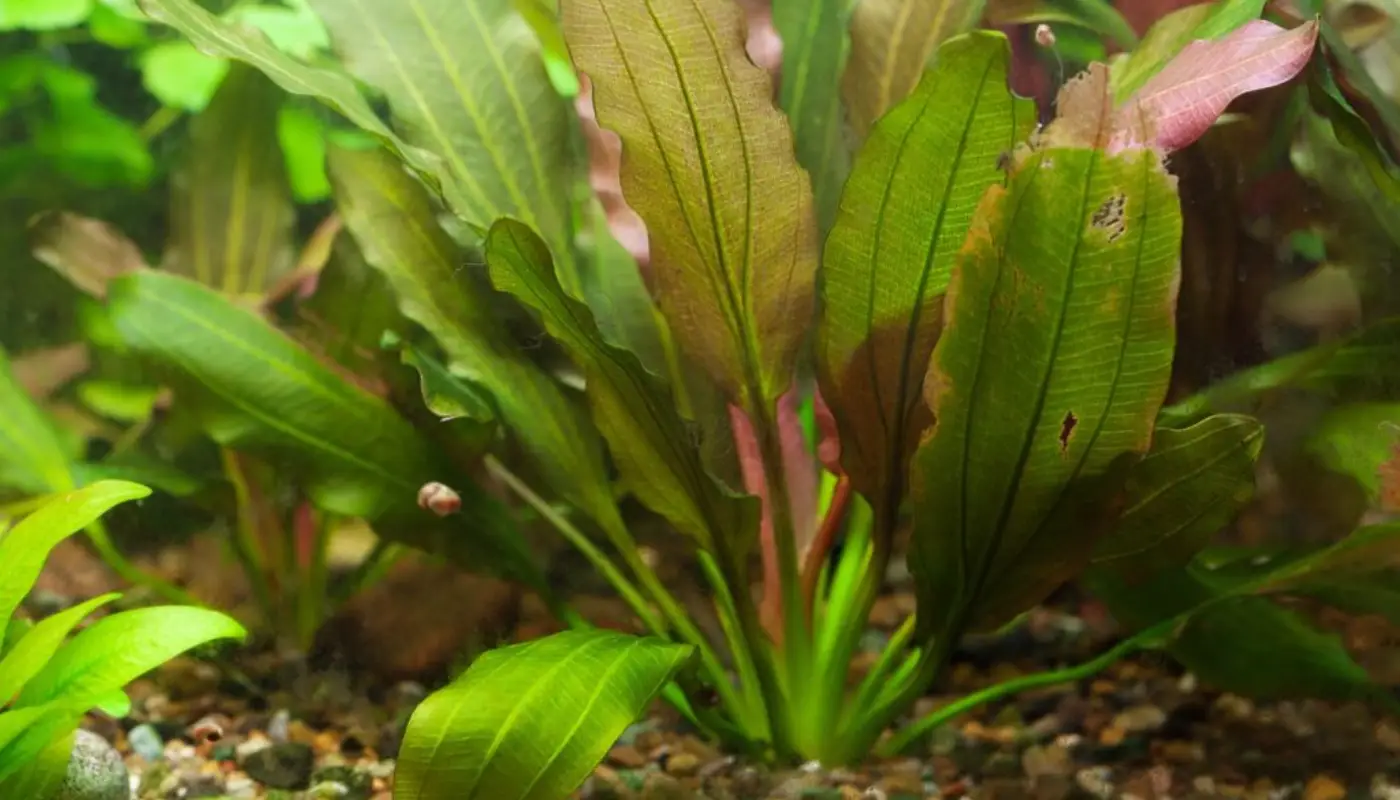
If you have a larger tank and need a larger plant that will provide a good cover for your Bettas, you can’t go wrong with Amazon Sword. Amazon Sword is popular for its big, broad leaves that some Bettas enjoy resting and sleeping on.
Unlike the two plants above, Echinodorus bleheri is a root-feeding plant. That means it feeds heavily from its roots and needs a nutrient-rich substrate or root tabs to stay healthy.
When the Amazon Sword becomes large enough, it may develop long spikes that form new plants that can be propagated in other Betta tanks.
4. Marimo Moss Ball (Aegagropila linnaei)
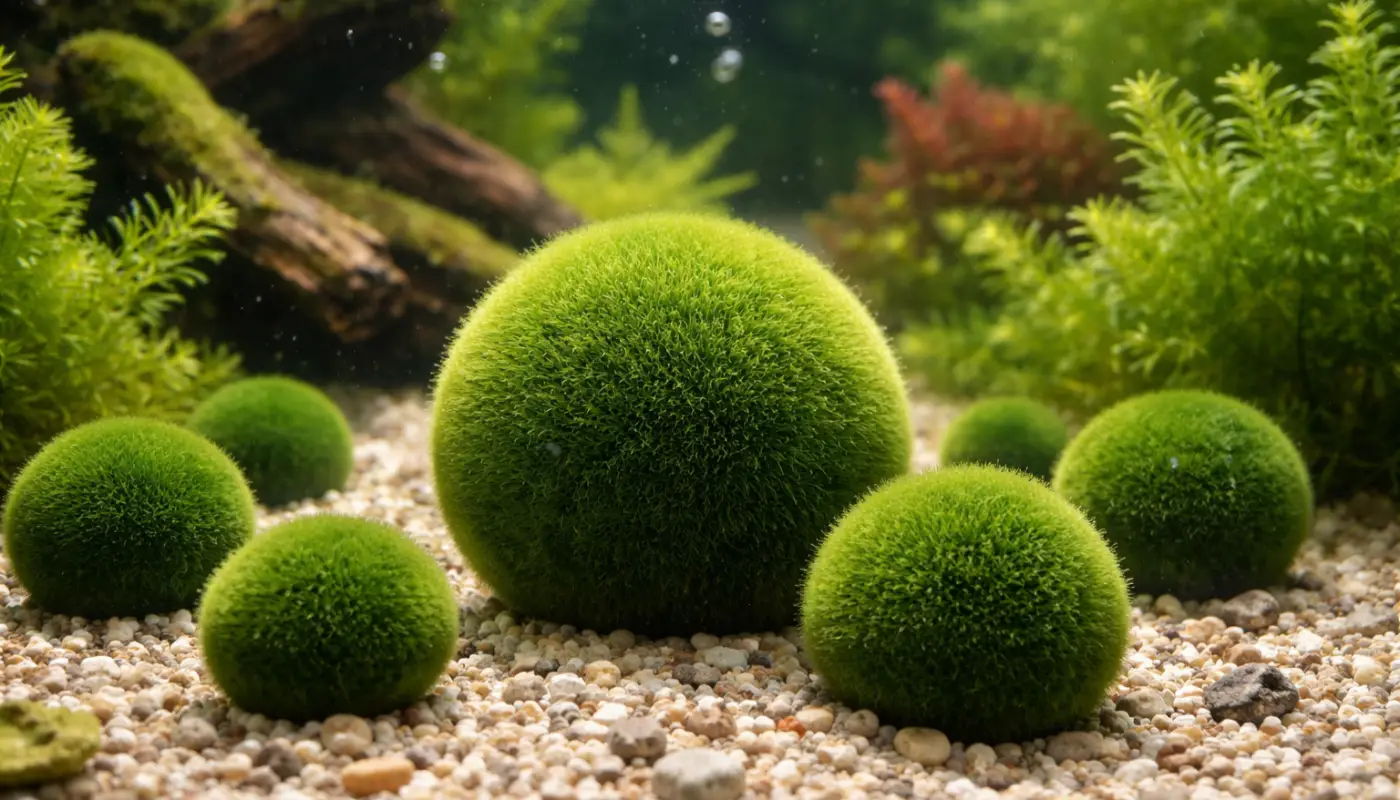
Marimo Moss Ball is not a true plant, but an algae that forms a fuzzy ball. As a result, it helps fight other algae by absorbing their nutrients. Marimo thrives in low light, requires low maintenance, and only needs occasional turning to maintain its shape.
When you’re looking for the easiest plant to add to your Betta tank, Marimo Moss Balls are the right choice. Just drop them in. They also make perfect toys for your Bettas to play and rest on.
Marimo Moss Balls are not only fun and fantastic, but they are also suitable for aquariums of all sizes.
5. Cryptocoryne (Cryptocoryne wendtii)
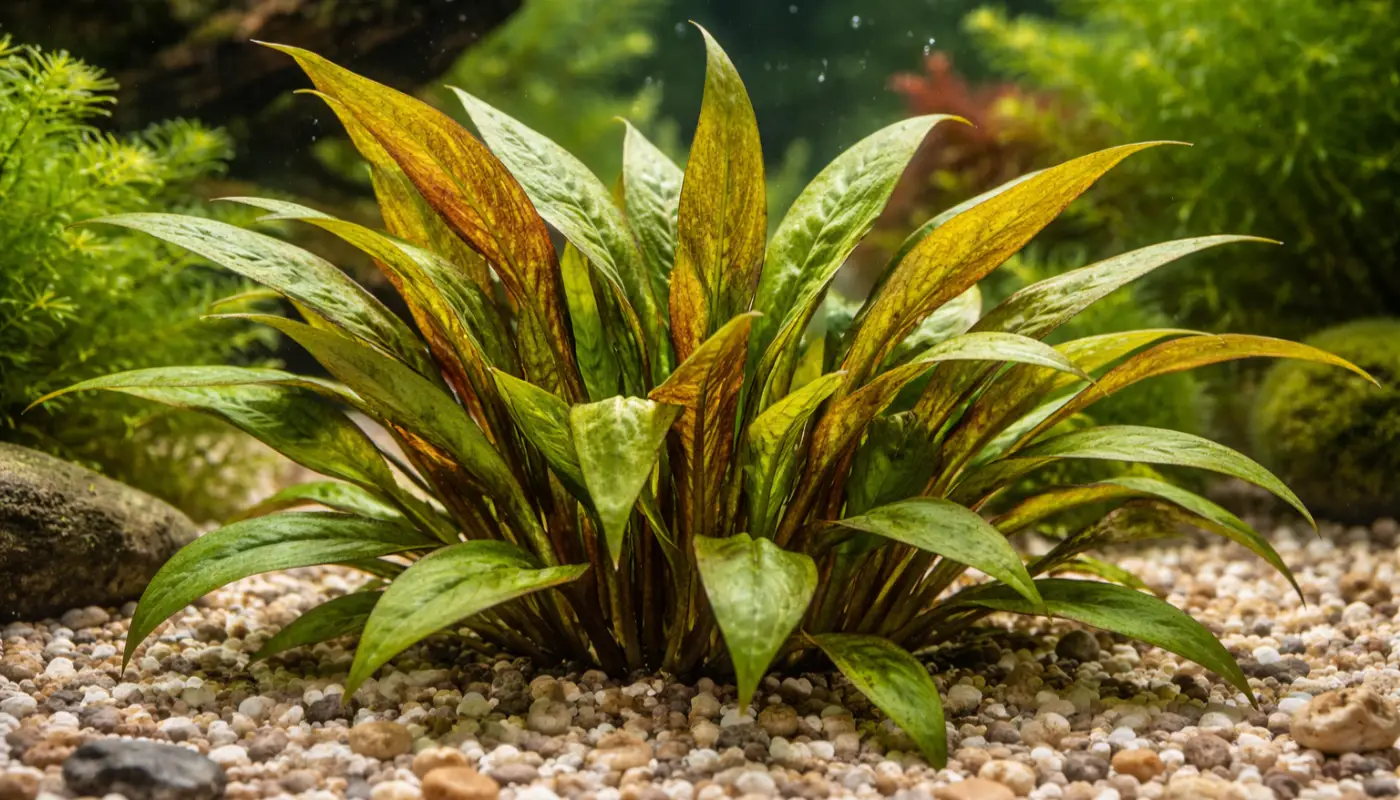
Cryptocoryne, commonly called “Crypts,” are well-known for their undemanding, low-maintenance care and ability to thrive in low to medium light.
Dwarf Cryptocoryne is colorful and available in several varieties, including red, green, bronze, and tropical. It has broad, wavy-edged leaves that Bettas love to rest on and hide in.
Being a root-feeding plant, Cryptocoryne prefers to take up its nutrients from the ground rather than the water column. Therefore, Cryptocoryne should be planted in a substrate that contains the necessary nutrients.
Cryptocoryne parva, a small variant with deep-green, slender leaves, is often used as a slow-growing foreground plant..
If you notice that your Crypts are wilting soon after purchase, don’t panic or throw them away. The plant is possibly experiencing what is called ‘crypt melt.’ Leave it in the aquarium for some time to recover and start growing new leaves.
6. Water Wisteria (Hygrophila difformis)
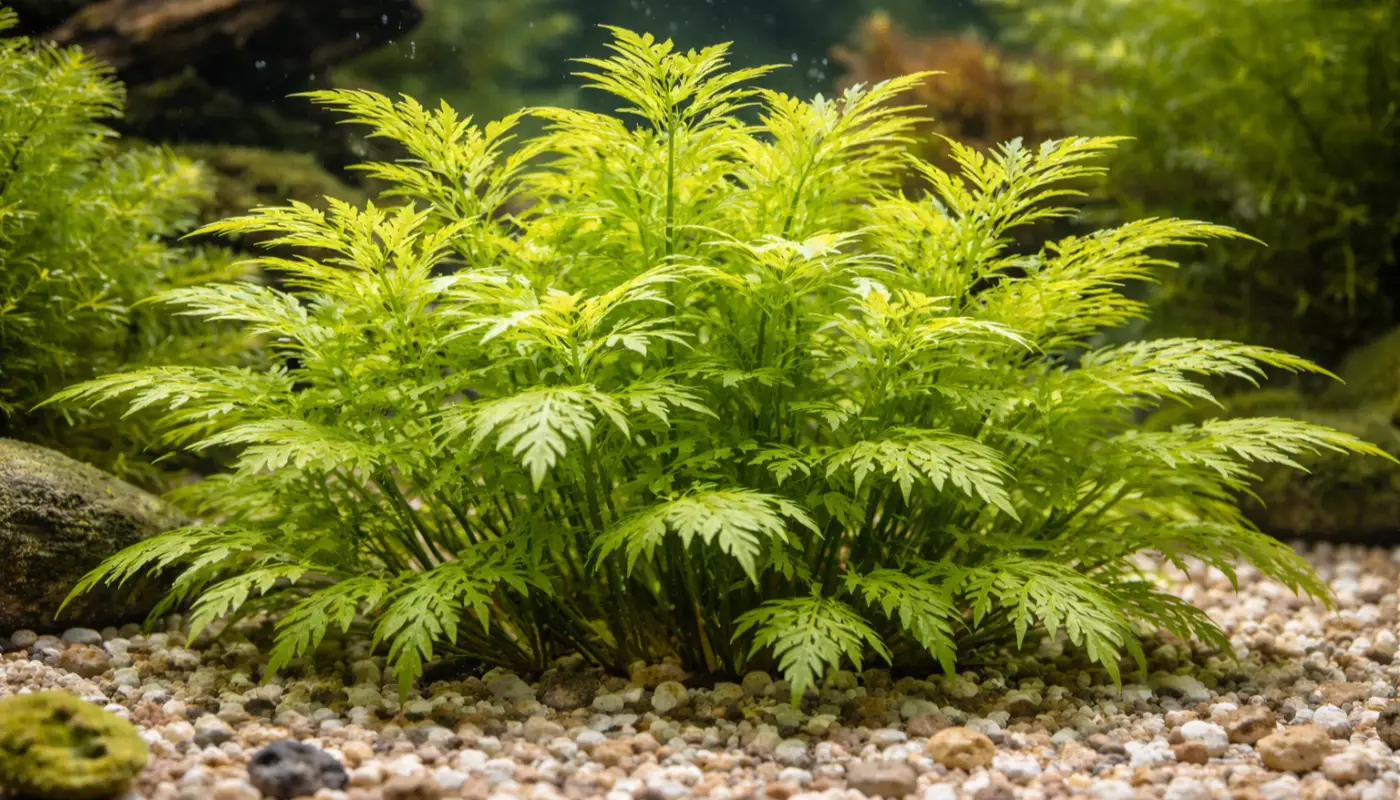
Water Wisteria is an effective, fast-growing aquatic plant with bright green color, soft, lacy leaves, and rapid growth. It is beginner-friendly, low-maintenance plant, and not demanding in terms of care.
Apart from being beginner-friendly, Water Wisteria replicates Bettas’ natural habitat, making them feel more comfortable in their home.
More so, the leaves’ lacy texture offers adequate protection for Bettas’ offspring. You wouldn’t be surprised seeing your Betta building its bubble nest near Water Wisteria.
This unique plant can take up its nutrients from both the ground and the water column. That means you can leave Water Wisteria to float in the aquarium or plant it in the substrate. However, we recommend leaving it to float if you’re keeping a male Betta.
Set up your aquarium with medium lighting to ensure that your plant doesn’t take over too much of the water’s surface.
Moreover, Water Wisteria helps to keep both ammonia and nitrate levels low in an aquarium. As a natural filter and nutrient sponge, it absorbs ammonia directly from the water and uses the nitrates as food for growth.
7. Vallisneria (Vallisneria spiralis)
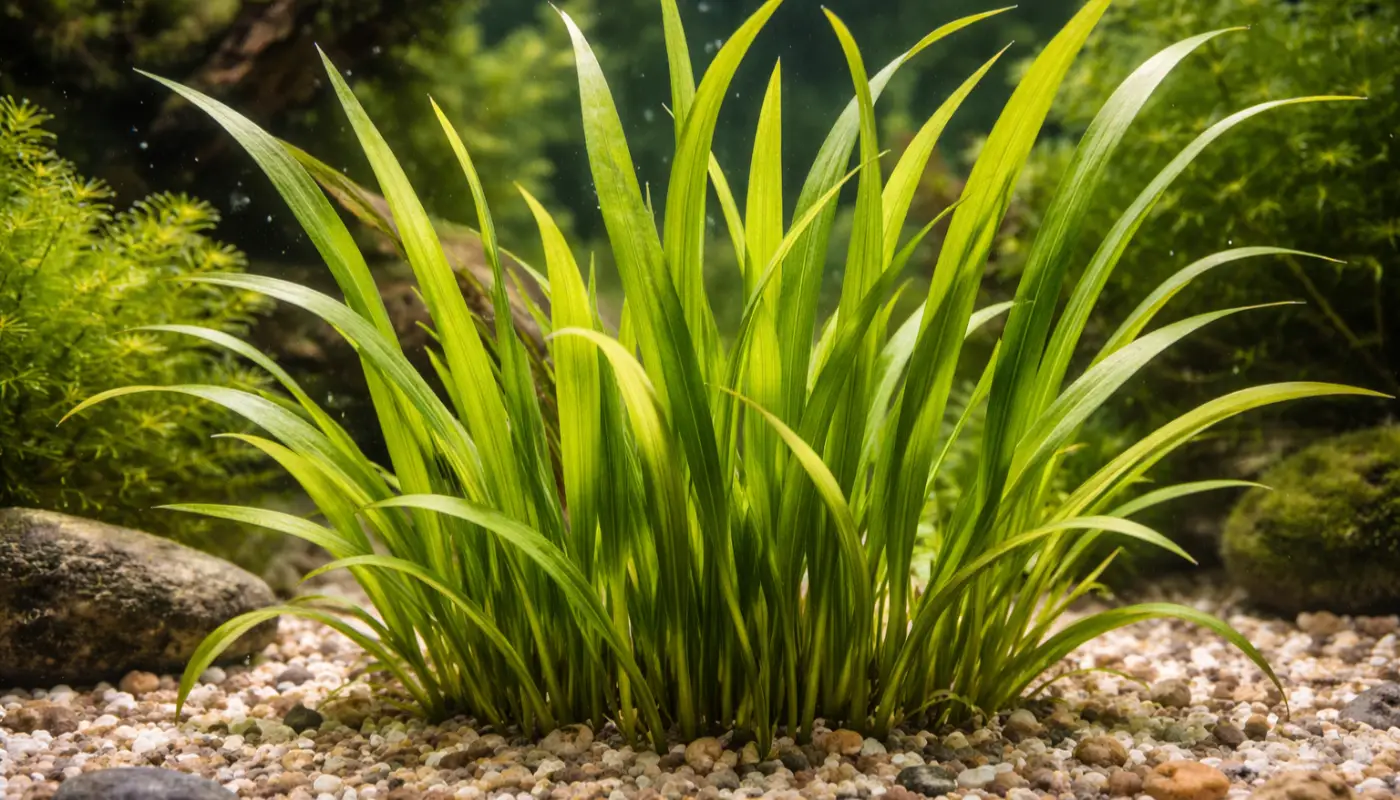
Here is a tall, easy-to-grow, aquatic grass-like background plant. It is very hardy and thrives in a wide range of environments.
Once Vallisneria gets well-established in your tank, it sends out new runners with new plants every few days, spreading like wildfire. This makes Vallisneria, often referred to as “val,” suitable for creating thick underwater meadows to fill the back of your natural-looking tanks.
Vallisneria is a root-feeding plant and needs a substrate to anchor its roots and absorb nutrients. It thrives in anything from gravel and sand to rich, aqua soil. Make sure the substrate is nutrient-rich or fitted with root tabs.
When planting, add a high-quality LED light to the aquarium and ensure the crown is above the substrate to prevent rot. Also, don’t keep Vallisneria in water that’s too soft or too acidic to get the best out of it.
Best Floating Plants for Betta Fish
Naturally, Betta fish love shaded areas because they feel more secure when they have places to retreat, rest, and hide. This is the reason why floating plants are ideal additions to a Betta tank, mimicking their natural habitats.
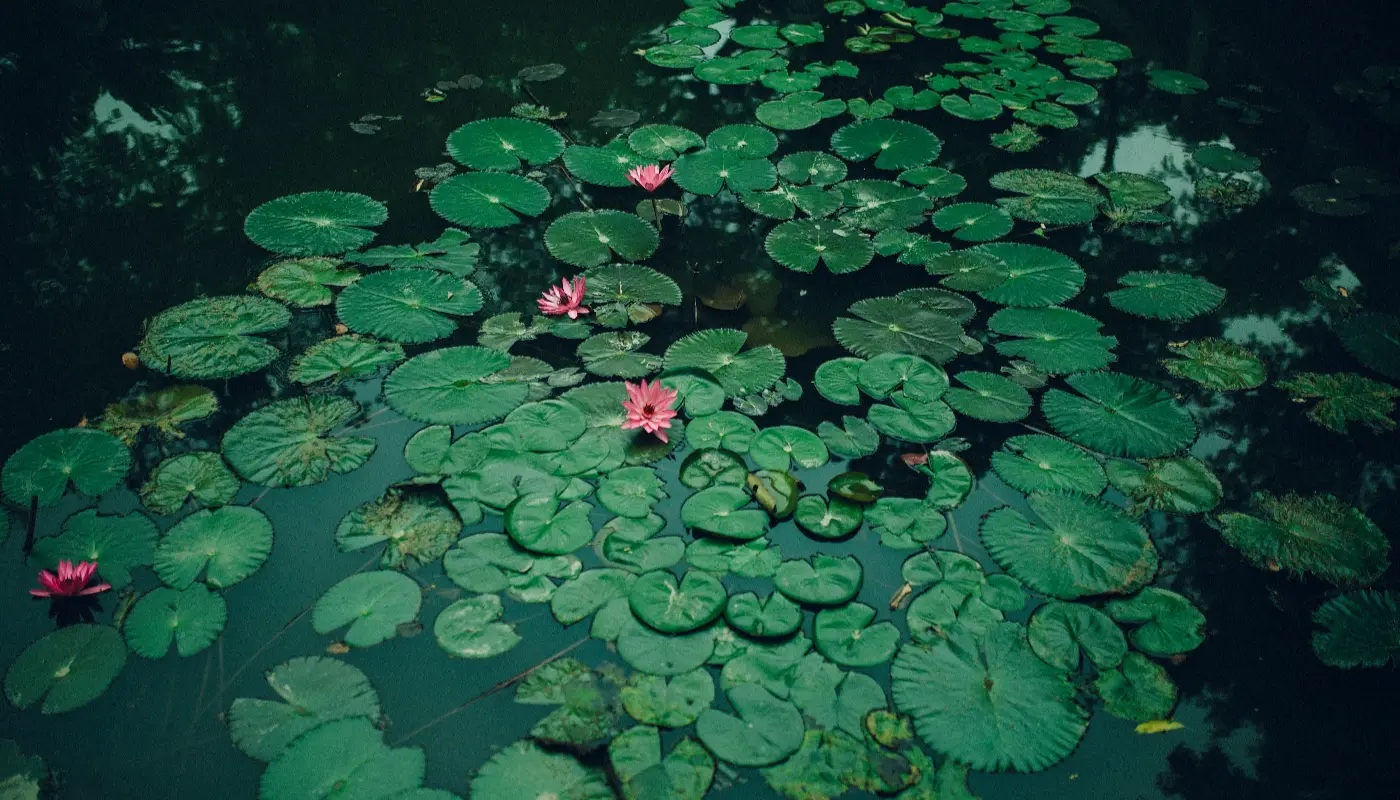
Floating plants help to create beneficial shaded areas, reduce harsh light intensity, and provide resting spots and cover for Bettas. As Bettas like to hang out near the water surface, floating plants for Bettas help reduce light intensity, providing a balance of light and shadow.
Aside from the natural shade, floating plants’ roots offer a great place for Betta fish to explore. Also, the roots absorb excess nutrients, helping to keep the water column clean.
The next section covers Betta-safe plants for your fish tank.
Top Floating Plant Options
Here are some of the best floating plants for Betta aquariums:
Amazon Frogbit (Limnobium spongia): This is a kind of Frogbit, well-known for its rapid growth rate, adaptability, spongy leaves, and long roots.
This plant prefers low to moderate light and has broad leaves for providing excellent surface cover and shade. The long, dense, extensive root system also offers playful exploration for the Betta fish.
Due to its rapid growth, Amazon Frogbit needs regular pruning to prevent overcrowding and ensure your Betta has a clear spot to gulp air at the surface.
Aside from providing shade and security for Bettas, Amazon Frogbit is an effective natural water purifier that cleans the water column.
Red Root Floaters (Phyllanthus fluitans): These plants have small, round, green leaves that turn a vibrant red or crimson under good lighting. The leaves form a dense surface mat that offers excellent cover and hiding spots for Betta fish.
Their delicate red roots also offer hiding places for the fish and give the tank a unique aesthetic.
Being a delicate plant, Phyllanthus fluitans does well with very little to no water surface agitation. Also, they don’t like to get wet on top, so slightly open the aquarium lid to prevent water condensation from forming on their leaves.
Duckweed (Lemna minor): This is a small, easy-to-grow, fast-growing, and free-floating aquatic plant. It quickly forms green mats that rapidly cover the surface of still fresh water, blocking sunlight.
Due to its incredibly fast growth rate, Duckweed can completely cover the aquarium surface, block gas exchange, reduce photosynthesis, and ultimately lower dissolved oxygen levels in the water.
Therefore, if unmanaged, Duckweed’s growth can cause death to your Betta fish by severely depleting oxygen. To prevent this, a regular management and maintenance culture is essential, which includes:
- Manually removing excess duckweed regularly to maintain open water surface areas.
- Agitating the surface of the water, as Duckweed doesn’t do well in high surface agitation.
Nevertheless, Duckweed is very effective at removing excess nutrients, helping to control algae and nitrates.
Dwarf Water Lettuce (Pistia stratiotes): This floating plant is suitable for medium- to large-sized Betta fish tanks, providing maximum shade for the fish.
It is similar to Amazon Frogbit, but with broad, velvety, rosetted leaves and a long, dense root system that stretches down into the water column. While the broad leaves provide good shade, the long roots offer playful places for the Betta fish to explore.
However, Dwarf Water Lettuce grows quickly and requires regular removal to prevent it from covering the entire water surface. Nevertheless, the fast growth helps to suck up all the excessive nutrients from the water, keeping nitrate levels at bay and preventing unwanted algae issues.
Plants to Avoid in Betta Tanks

Whether live or artificial, not all plants are safe for Betta fish. There are some plants to avoid in Betta tanks, as they may pose risks to your Betta’s health and delicate fins.
That being said, avoid:
Silk and plastic plants with sharp edges: Strictly avoid any artificial plants, whether plastic or silk, with sharp edges. The rigid edges on most artificial plants are often sharp and can easily tear the Betta fish’s fins, leading to stress, injury, or potential infection.
If you need to use an artificial plant, run your fingers over all parts to ensure there are no sharp edges before placing it in the tank.
Always choose plants with soft leaves and edges, as Betta fish, especially the long-finned varieties, have delicate fins that can easily tear on stiff or sharp decorations.
Unstable or toxic plants: Avoid toxic or non-aquatic houseplants that have been treated with fertilizers or pesticides. The chemicals on treated or toxic houseplants can be highly toxic to your Betta fish.
Also, avoid well-known poisonous plant species, such as Marsh Marigold and Water Hemlock, when seeking plants for your Betta fish.
Plant species requiring high CO₂ or intense light: Avoid high-demand aquatic plant species that require high CO₂, intense lighting, or high-tech fertilization, such as Rotala macrandra.
Such plant species will often die off in a low-tech aquarium, causing an ammonia spike and fouling the water column. We recommend sticking to low-light species, such as Anubias and Java Fern.
How to Choose the Right Plants for Your Betta Tank

Choosing the right live plants for your betta tank ensures a thriving, natural, low-stress environment for your betta. Here is a guide to choosing the best plants for your betta tank.
Note that the key is to choose low-maintenance, soft-leaved plants that are compatible with a Betta’s needs.
- Consider the tank size: Almost all floating plants require tanks of medium to large size (above 5 gallons). If you have a smaller tank, choose compact, slow-growing plants, such as Marimo Moss Balls and Anubias. If you have a large tank, consider varieties like Cryptocorynes and Amazon Swords.
- Lighting level: Betta tanks often have low lighting, suitable for plants that thrive in low light, such as Java Moss and Java Fern. However, if you install moderate lighting in your tank, you can add plants like Water Sprite.
- Substrate needs: Epiphytic plants do not require soil or substrate; they thrive attached to a driftwood or rock using any suitable material. Rooted plants need a nutrient-rich substrate or, at a minimum, plain sand/gravel with root tabs.
- Maintenance level: If you’re a beginner and want a low-maintenance setup, choose slow-growing, low-maintenance species like Water Wisteria and Marimo Moss Ball. If you choose rapid-growing plants like Frogbit, be prepared to regularly thin them to prevent them from smothering your Betta.
- Compatibility with other tank mates: Finally, you need to consider the other aquatic life you have in your tank. For instance, if you have snails or shrimp in your tank, mosses and plants with dense, extensive root systems can provide crucial hiding places for them.
Focusing on these factors is essential for creating a healthy, stimulating, and beautiful environment for your Betta fish.
How to Plant and Care for Betta Aquarium Plants
Here is a brief guide on how to plant and care for Betta aquarium plants:
Preparing the plant
Gently rinse the plant to remove dirt, debris, and any potential pests. Inspect the root to remove any rock wool or ties. We recommend dipping the plants in a mild bleach or alum solution to sanitize them and kill any hitchhikers. After that, rinse the plant thoroughly with dechlorinated water.
Planting in the tank
Root-feeder plants: For rooted plants, such as Amazon Sword and Cryptocoryne, plant the root a half-inch or so into a nutrient-rich substrate like aquasoil or active clay/sand substrate. If you plant them in plain soil or inert gravel, you must use root tabs near the roots of the plants, especially for plants that feed primarily through their roots.
Epiphytes: For epiphytic plants, don’t bury the rhizome in the substrate, or it will rot. Instead, attach it to a driftwood or rock using any suitable material, such as cotton thread, fishing line, or aquarium-safe.
Floating plants: For floaters such as frogbit, simply place them on the water surface; their roots will dangle. For some unique plants, such as Marimo Moss Balls, simply drop them in the tank. Roll them gently every few weeks to maintain their shape and expose all sides to light.
For root feeder plants to thrive, use nutrient-rich soil or a planted tank substrate like Fluval Stratum. Otherwise, supplement your standard sand or gravel with root tabs.
Essential Care and Maintenance
- Simple fertilizing routine: For most easy Betta aquarium plants, the primary nutrient source is the fish waste from the water column. However, if necessary, you can supplement this with a liquid all-in-one fertilizer once a week. Remember to use root tabs for the root feeders.
- Lighting: Most beginner-friendly Betta plants are low-light aquarium plants. For plants that require moderate lighting, use an aquarium-specific LED light, and set it on for 6 to 8 hours per day. This lighting period is enough to help the plants grow and prevent excessive algae growth.
- Trimming and maintenance: Floating plants are known for rapid growth. Trim overgrown floating plants weekly to ensure that your betta fish has access to open water surface to breathe. For rooted plants, trim yellowing or decaying leaves to maintain health and prevent water fouling.
- Algae prevention: In addition to using plants that absorb excess nutrients and maintaining 6 to 8 hours of lighting daily, you can also introduce a natural algae eater, such as a Nerite Snail, to prevent algae growth. Also, make sure you perform weekly water changes of 20 to 30% to keep nitrate levels low.
Low-Maintenance Plants for Beginners
If you’re just starting a planted Betta tank, focusing on low-maintenance plants that thrive without high-tech equipment is key. Plants, such as Anubias, Java Fern, Crypts, and Marimo Moss, are perfect for a low-tech setup.
| Plants | Why they thrive in low-tech setups | Planting method |
| Anubias | Extremely hardy, very slow-growing, and does well in low light. Its broad leaves are perfect rest spots for a Betta. | Attach the plant to a driftwood or rock; do not bury the thick rhizome. |
| Java Fern | Tolerates a wide range of water conditions and low light. Its texture provides great cover. | Attach the plant to a driftwood or rock; do not bury the thick rhizome. |
| Cryptocoryne (Crypts) | Once established, they are very sturdy and only need root tabs for long-term health. They create a beautiful, dense mid-to-foreground cover. | Bury roots into a nutrient-rich substrate, or supplement plain soil or inert gravel with root tabs. |
| Marimo Moss Ball | Technically algae, they require almost no light and are fantastic natural filters. Bettas often nudge them around. | Simply drop them into the tank. |
Final Thoughts — Creating a Comfortable Planted Home for Your Betta
Creating a comfortable home for your Betta fish goes beyond just a beautiful aquarium, clean water, and good food. Adding a live plant is undoubtedly one of the most impactful improvements you can make to their home.
Live plants not only enhance the aesthetic appeal of your aquarium but also offer many benefits for your betta. They mimic Betta’s natural habitat, provide natural hiding spots and soft resting places, and improve water quality by absorbing nitrates.
In 2025, the core advice is to consider hardy, low-light plants that can tolerate a range of conditions. Use floaters to act as a cover, providing your betta fish with a sense of security and shielding it from bright lights.
Finally, focus on simple care routines, which include providing root tabs for root feeders and occasional pruning for floaters. We recommend starting with 3 to 5 easy plant species from the list above to observe how your betta interacts with them and how they thrive in your aquarium.
Frequently Asked Questions (FAQs)
No, Bettas do not need live plants in their tank to survive. However, adding live plants to Betta tanks is highly recommended for the significant benefits they offer. Live plants provide shade and natural hiding/resting places for Bettas, and also help to absorb harmful nitrates.
The easiest plants for Betta fish are low-light varieties that do not require specialized substrates or CO₂ injection. Some of the easiest plants for Betta fish include Anubias, Java Fern, Java Moss, and Marimo Moss Ball.
Yes, floating plants are good for bettas because they provide shade and natural filtration. The long, dense, extensive root system also offers playful exploration for the Betta fish. However, if unmanaged, they can cause your Betta fish to die by severely depleting oxygen. To prevent this, manually remove excess plants regularly to maintain open water surfaces.
No, Betta fish cannot eat aquarium plants. Bettas are basically carnivores and only feed on small insects, larvae, and crustaceans. Nevertheless, they may occasionally nip a plant or leaf.
This often depends on the type of plant you choose. All root feeders require nutrients at their roots and need a special substrate or root tabs. However, epiphytes do not need a special substrate.